Un opérateur intégré pour la valorisation de vos actifs énergétiques
As an aggregator, flexibility provider, and energy supplier, Symphonics connects, manages, and maximizes the value of your energy assets through a unique multi-market optimization approach. We maximize your revenue without compromising your operational constraints.
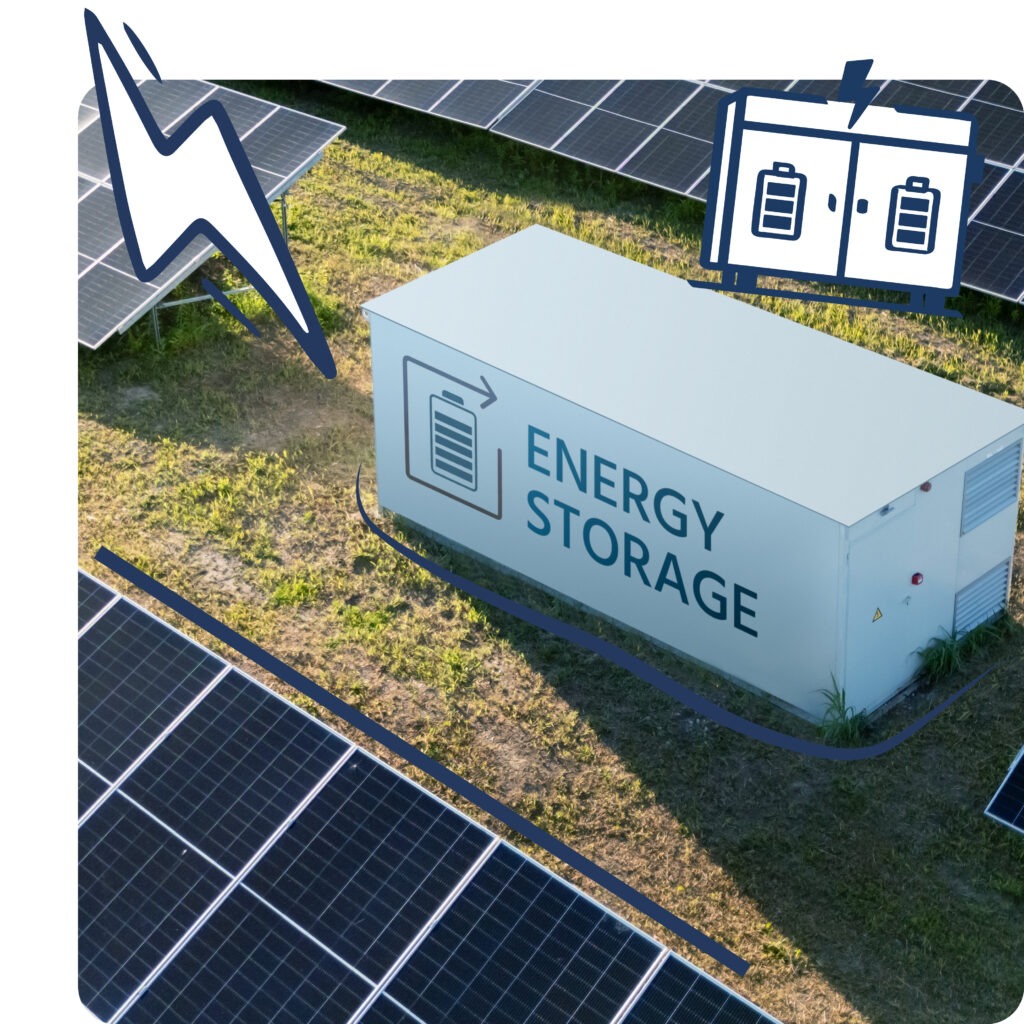
Symphonics offers standalone and behind-the-meter battery solutions, in both low-voltage (LV) and high-voltage (HV) configurations, up to 20 MW. A behind-the-meter battery is installed behind a site’s meter: it optimizes both local energy costs and market revenue; a standalone battery is connected to purchase, store, and resell energy and grid services.
Symphonics offers turnkey support, from developing the business plan and obtaining certification to delivery (including shipping), management, and battery recovery.
We manage the entire value chain in-house, without outsourcing any activities, because it is necessary to align revenue and costs for effective management.
Our optimization engine balances reserves, flexibility mechanisms, capacity, and energy markets to maximize value subject to technical constraints.
What Symphonics Offers
An integrated solution for batteries, whether installed at a consumer/producer site or connected as a standalone system.
Revenue analysis, business plan, sensitivity analysis, selection of power/capacity, and consideration of grid and supply costs.
Symphonics maximizes the value of batteries across all electricity markets: system reserves (aFRR), capacity mechanisms, balancing mechanisms, and energy markets—Spot, Intraday, and balancing—by continuously balancing these various levers to maximize their value.
Integrated electricity supply when the battery draws power from the grid, in order to control the actual cost of the cycles.
Certification, management, trading, and operations are handled by the teams and the Symphonics platform, ensuring end-to-end accountability.
How does it work?
Our value proposition is to maximize the battery's value by allocating its capacity to the right market at the right time.
Reserves generate revenue based on availability and/or rapid activation; energy markets generate revenue based on price differentials between charging and discharging. The capacity mechanism and other forms of flexibility generate additional revenue depending on the asset’s eligibility.
In addition to "behind the meter," there are self-consumption, rate arbitrage, and TURPE optimization to reduce contracted power and utility bills.
Performance, then, comes from revenue stacking: combining multiple strategies without unnecessarily draining the battery and ensuring that each cycle generates value.
Equipment Control
Symphonics optimizes active power, SoC, cycle life limits, efficiency, and manufacturer specifications in real time.
The engine continuously compares the expected values of reserves, spot prices, intraday prices, and local consumption.
It decides whether to load, unload, or retain available capacity based on the best economic opportunity, adjusted for risk.
For a BTM battery, it also takes into account the site's consumption, PV generation, TURPE, and the supply contract.
The result is a unique strategy that protects the asset while maximizing its operating margin.
Example
A 240 kW / 2-hour BT battery is installed at a commercial site equipped with solar panels.
From 11 a.m. to 3 p.m., it absorbs excess solar power or charges when the spot price of electricity is €21/MWh on May 15, 2026. At 8 p.m., it discharges at a feed-in tariff of €123/MWh, helping to reduce the site’s electricity purchases and peak power demand.
When the grid value is higher, a portion of its capacity is reserved for flexibility or reserve markets.
Symphonics It integrates these factors into a single algorithm and calculates the net value after accounting for energy, TURPE, efficiency, and degradation.
We use cookies to ensure you have the best experience on our website. If you continue to use this site, we will assume that you are satisfied with this.